

Today, 83% of patients read online reviews before choosing a dentist (source), yet most dental practices still rely on the same generic review request methods and get average results.
The practices consistently generating high-quality Google Business Profile reviews are using smarter timing, better communication, and systems built around patient psychology rather than random automation alone.
In this guide, we’ll break down the review-generation tactics that actually work for dental practices in Toronto and across Canada, and why consistent execution usually requires a dedicated internal team or agency partner.
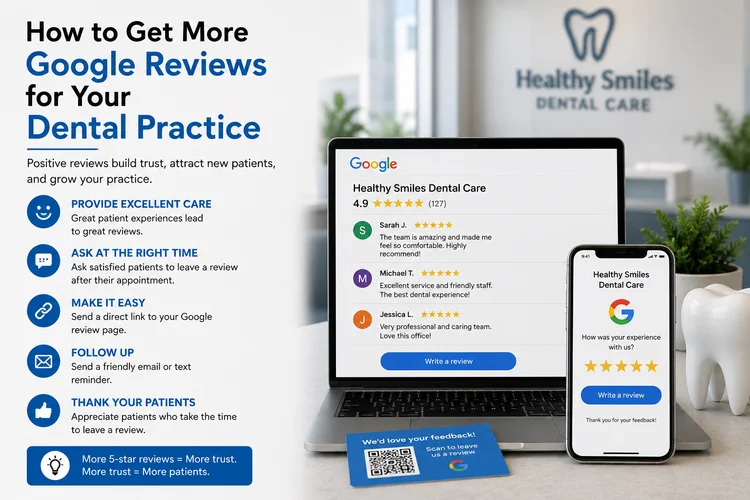
Why Google Reviews Are a Ranking Signal
Google reviews do far more than build credibility. They directly influence how dental practices rank in Google Maps and local search results.
Practices with stronger review profiles often receive significantly more clicks, calls, and appointment requests than competitors with weaker reputations. Research also shows that businesses with higher review ratings can experience meaningful increases in conversion rates and revenue.
For dental practices, reviews are not a vanity metric. They are a local SEO signal, a trust signal, and a patient acquisition tool all at the same time. A consistent flow of authentic reviews helps Google view your practice as more prominent, more active, and more trustworthy in local search.
The Tactics Most Dental Practices Have Never Tried
Most dental practices rely heavily on automated email requests and generic SMS follow-ups. While those tactics still matter, the highest-performing practices use timing, personalization, and patient psychology to increase review conversion rates in ways competitors rarely consider.
1. Ask at the Emotional Peak, Not at Checkout
The best time to ask for a review is often the exact moment a patient expresses relief or gratitude, not when they are distracted at the payment desk.
If a patient says something like:
“That was easier than I expected.”
or
“You made me feel really comfortable.”
Staff should be trained to recognize that emotional peak and make the request immediately while the positive experience is still emotionally active.
2. Use the Second Visit to Catch Patients Who Never Reviewed After the First
Many patients ignore automated requests after their first appointment, but become much more likely to leave a review after returning for a second visit.
A simple front-desk line such as:
“We’re glad you came back. If you’ve had a good experience, even a quick Google review means a lot to us.”
feels more personal and natural than a cold follow-up email.
3. Personally Ask Long-Term Patients Who Have Never Been Asked
Patients who have been visiting your clinic for years are often your most loyal supporters, yet many practices never directly ask them for reviews.
A short, personal request from the dentist, rather than an automated system, often generates significantly better response rates because the relationship already exists.
4. Send a Review Request on the Patient’s first Dental Anniversary
Most review requests are expected. Anniversary messages feel personal and unexpected.
A simple automated message like:
“It’s been one year since your first visit — we’d love to hear about your experience.”
creates a positive touchpoint without feeling transactional.
5. Put QR Codes Inside the Take-Home Care Bag — Not Just at the Front Desk
Patients standing at the reception desk are usually distracted by payment, scheduling, or insurance discussions.
A QR code placed inside the patient’s take-home dental care bag gets seen later at home, when the patient is more relaxed and more likely to follow through.
6. Add a Live Review Widget to Your Website With a CTA Beside It
Most dental practices display Google reviews on their website, but fail to place a review CTA beside them.
Adding a “Leave Your Own Review” button directly next to existing patient testimonials creates a much stronger conversion opportunity because the trust signal and action happen in the same visual space.
This is what the official website ofGoogle Business Profile Help says:
“Reviews can help your business stand out and give potential customers helpful info. They show next to your Business Profile in Maps and Search.”
7. Integrating Review Requests into the Patient Journey
A successful strategy for getting Google reviews for dental involves making the request a natural part of the patient experience, not an afterthought. This means incorporating review prompts at various touchpoints.
- Before the Appointment: Set the stage for a positive experience. Clear communication about what to expect, online forms for convenience, and a welcoming atmosphere reduce patient anxiety. A positive experience is the best foundation for a good review.
- During the Appointment: Focus on exceptional service. A friendly team, clear explanations, and efficient care all contribute to a positive patient feedback dental clinic experience. While you shouldn’t ask for a review in the chair, these interactions pave the way.
- After the Appointment: This is the prime time for your automated request. As mentioned, an email or text with a direct link is highly effective. You can also place discreet signage in your reception area with a QR code linking to your review page. This provides an easy option for those who prefer to leave feedback on the spot.
Remember, the goal is to make it effortless for patients to share their positive experiences. The less friction, the more reviews you will accumulate for your dental practice.
8. Build a Team Review System With Monthly Targets
Dental practices that consistently generate reviews usually treat review generation as a team responsibility rather than an occasional task.
Set monthly targets, track progress internally, and recognize staff members who consistently contribute to positive patient feedback.
Google also tends to distrust sudden bursts of reviews from the same location or device, so steady consistency is far more effective than aggressive short-term campaigns.
What to Avoid: Mistakes That Can Get Reviews Removed
Google’s spam detection systems are far more advanced than most dental practices realize. Aggressive review tactics can lead to reviews being filtered, removed, or ignored entirely.
Common mistakes include:
- buying fake reviews
- incentivizing reviews with discounts or gifts
- asking staff or family members to leave reviews
- using review-gating software
- generating large bursts of reviews from the same IP or device
Consistency and authenticity always outperform manipulation in the long run.
How to Respond to Reviews in a Way That Generates More of Them?
Getting reviews is only half the battle. How you respond to them is equally important for your online reputation and dental practice. This shows current and future patients that you are engaged and value their opinions.
Responding to Positive Reviews
Always thank patients for their kind words. A simple, personalized thank you reinforces their positive experience and shows appreciation. Mention something specific from their review if possible. This makes your response feel genuine, not automated.
Example: “Thank you, [Patient Name], for your wonderful review! We are so glad you felt comfortable during your recent check-up. We look forward to seeing you again.”
Responding to Negative Reviews
Respond to negative dental reviews promptly and professionally. Never get defensive. Acknowledge their concern, apologize for any dissatisfaction, and offer to resolve the issue offline. This demonstrates your commitment to patient satisfaction, even to those who had a less-than-ideal experience.
Example: “We are truly sorry to hear about your experience, [Patient Name]. We take all feedback seriously and would like to understand more about what happened. Please contact our office manager at [Phone Number] so we can address your concerns directly.”
By handling negative feedback gracefully, you can often turn a potentially damaging situation into an opportunity to showcase your dedication to patient care. Health Canada guidelines also underscore the importance of patient safety and clear communication, which extends to how clinics handle feedback.
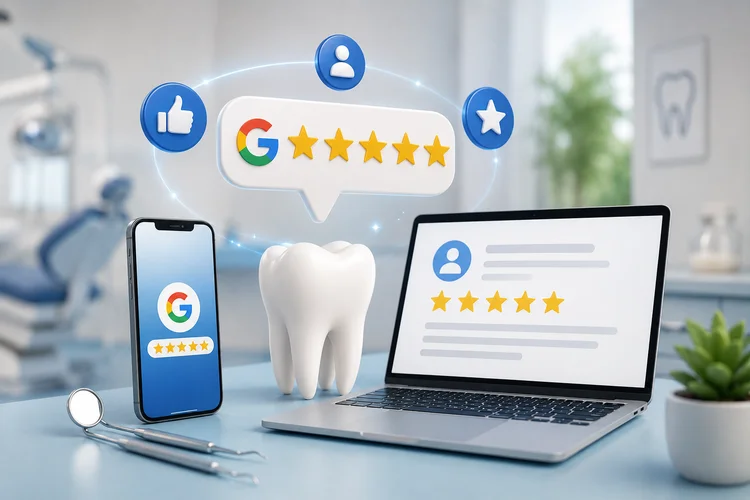
Leveraging Google Reviews for Marketing and Growth
Once you start to get more Google reviews for your dental practice, don’t just let them sit there. Use them! Your positive reviews are powerful social proof that can be integrated into your broader dental marketing and dental SEO efforts.
Share snippets of your best reviews on your website, social media channels, and in your email newsletters. This highlights patient satisfaction and reinforces your practice’s positive reputation. You can create graphics with review quotes for your social media marketing campaigns.
When potential patients in Toronto search for terms related to dental clinics, for Example: dentistry in Toronto, Google reviews have a huge impact on their decision.
A strong star rating and numerous positive comments will push your practice higher in local search results and significantly increase your click-through rate. This direct impact on patient acquisition makes review generation a critical investment.
Conclusion
Dental practices dominating local Google Maps rankings are rarely succeeding by accident. They have systems in place that consistently generate reviews, strengthen patient relationships, and reinforce trust over time.
But building and managing those systems requires consistent execution — from staff training to automation workflows and reputation management monitoring.
At CMC Marketing Agency, we help dental practices across Toronto and Canada create sustainable review-generation strategies that improve visibility, patient trust, and long-term growth.
If you want confidence instead of uncertainty, call us today at (866) 405-3006 and let’s discuss your clinic’s next move.
FAQ
How often should I ask for Google reviews?
Aim for consistency. With an automated system, you can set it up to send a request after every appointment. This ensures a steady flow of feedback without overwhelming patients.
Can I remove a negative Google review?
Generally, no. Google only removes reviews that violate its content policies (e.g., spam, hate speech, off-topic). You cannot remove a review simply because it’s negative. The best approach is to respond professionally and try to resolve the issue offline. We do this at Reputation Management for Dentists in Toronto.
Is it okay to ask friends and family for reviews?
It’s generally not recommended. But it’s better to have real reviews from real users.
What if a patient leaves a review but doesn’t mention specific details?
Even short reviews like “Great dentist!” are valuable. While detailed reviews are helpful, any positive feedback contributes to your overall star rating and social proof. A simple “Thank you for your kind words!” is a perfectly appropriate response.