

Local Services Ads can be worth the investment for dentists when the practice is eligible, completes Google’s verification process, responds quickly to inquiries, and tracks which leads become booked patients.
Suggested reading: Google My Business for Dentists
They provide prominent local visibility and charge for leads instead of ordinary website clicks, but they should not replace Dental SEO or professionally managed Dental PPC campaigns.
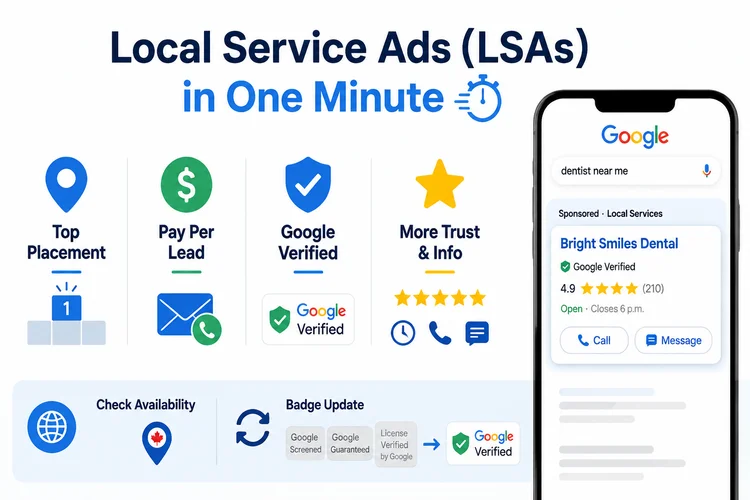
Local Service Ads (LSAs) in One Minute
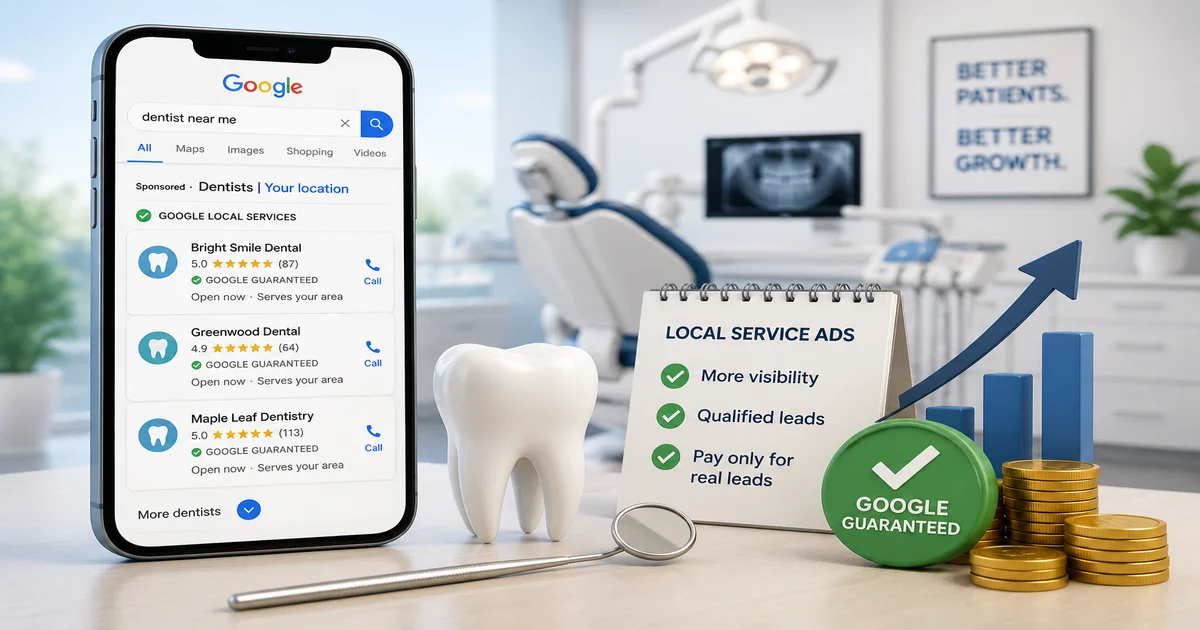
Google Local Services Ads, or LSAs, are a pay-per-lead advertising format that connects nearby patients with verified local providers. They can appear in a prominent position at the top of Google Search, above conventional PPC advertisements and local organic results.
Google explains that Local Services Ads help businesses connect with customers searching for their services, and that businesses are charged only for valid leads rather than clicks.
Three features define LSAs: top placement, a pay-per-lead model in which the clinic pays when a prospective patient contacts it, and the Google Verified badge awarded to eligible businesses that complete screening. Listings may also display Google reviews, a star rating, business hours, and direct call or message options.
Older Local Services Ads may display labels such as Google Screened, Google Guaranteed, or License Verified by Google. Google began replacing these older labels with the unified Google Verified badge on October 20, 2025.
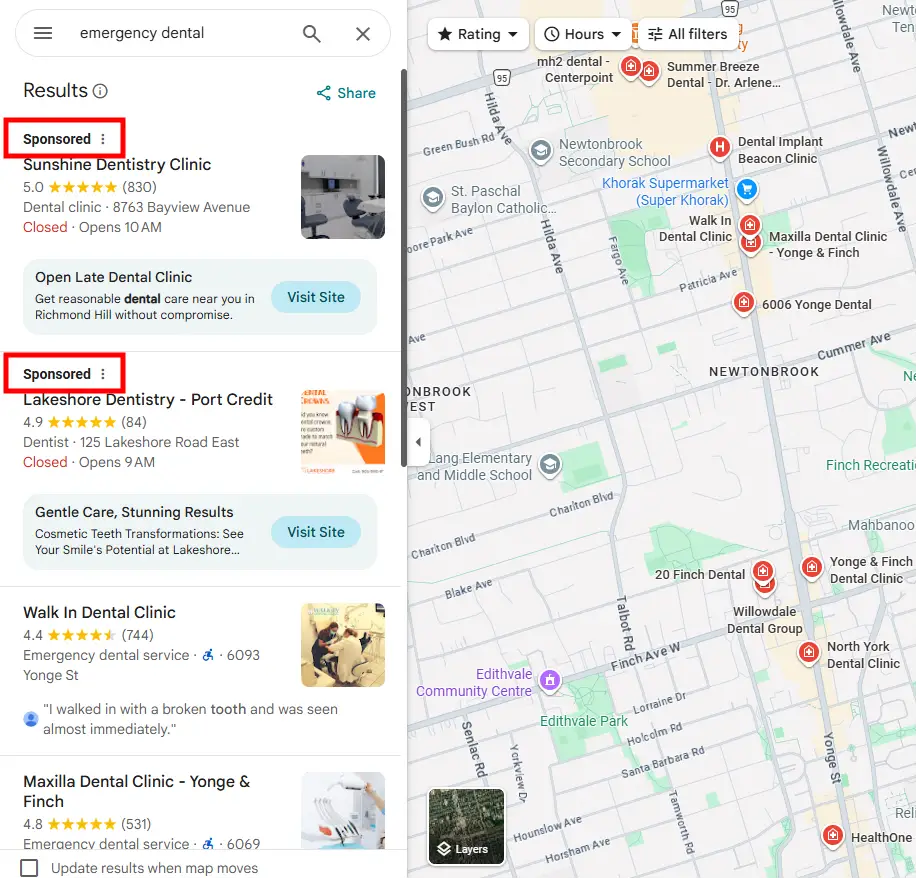
Availability differs by location and business category. Canadian dental practices should confirm that Local Services Ads are available for dentists in their area before planning a campaign.
The Difference Between Local Service Ads and PPC
PPC means pay-per-click. Both advertising formats can place a dental clinic prominently on Google, but they charge different amounts and offer varying levels of control.
| Local Service Ads | Google Ads (PPC) |
|---|---|
| Pay per qualified lead (call or message) | Pay per click |
| Appears at the top of search results above PPC ads | Appears below LSAs and above organic results |
| Shows the Google Verified badge after screening | Does not include the Google Verified badge |
| Uses broad service categories and service areas | Offers keyword, audience, device, schedule, and demographic targeting |
| Focuses on calls, messages, or direct inquiries | Sends users to websites or landing pages |
The average cost varies depending on industry, location, and competition. According to WordStream benchmarks, dental PPC campaigns often have higher CPCs than those in many other industries.
- LSAs focus on direct patient inquiries: Your clinic pays when an eligible patient calls or sends a message instead of paying for every website visitor.
- PPC offers greater campaign control: Google Ads allows you to target specific treatments, keywords, schedules, locations, and landing pages.
- LSAs require business verification: PPC campaigns do not display the same Google Verified badge or use the same screening process.
For a broader comparison of paid advertising and long-term search strategies, read our guide to SEO vs. PPC for dental practices.
What They Cost and How You’re Charged
Local Services Ads do not have one fixed price. Your dental practice sets an average weekly budget based on the number of leads it wants to receive, and Google charges the account when a valid lead contacts the clinic through the advertisement.
A valid lead may be a phone call, message, or supported booking request from someone looking for a dental service your practice offers. Weekly spending may fluctuate depending on patient demand, competition, and how often your advertisement is displayed.
A Toronto dental clinic should not assume that another clinic’s cost per lead will apply to it. The cost varies by city, service category, local competition, patient demand, and the number of other verified advertisers in the same area.
Google may provide credits for unsuitable leads, including spam, wrong numbers, duplicate inquiries, or requests for services your clinic does not offer. Review the lead inbox regularly and report invalid leads when available.
The real value of an LSA campaign should be measured using:
- The percentage of leads that become booked appointments
- The cost per acquisition for an actual patient
- The value of treatment accepted by each patient
- The patient’s expected lifetime value
A more expensive lead that becomes an implant or Invisalign patient may be more profitable than several cheaper calls that never result in appointments. Judge performance through cost per acquisition and patient lifetime value, not only the price of an individual lead.
Can Everything Be Solved by Paying Money?
Paying for Local Services Ads does not automatically make a dental clinic eligible or guarantee that its ads will appear. Google requires screening and verification before awarding the Google Verified badge, which replaced the older Google Screened and Google Guaranteed labels in October 2025.
Google introduced the Google Verified badge as a unified verification system, replacing older labels including Google Screened and Google Guaranteed.
Approval may require a dental license, business registration, identity and background checks, professional liability insurance, and a verified Google Business Profile. Ontario dentists should ensure their details match their RCDSO registration and all documents use the same clinic name, address, and phone number. Because verification may take several weeks, clinics should begin early.
Documents required for Google Ads approval
Need help setting up Local Services Ads for your dental practice or want to run your own campaign?
Contact CMC Marketing Agency for support with Google verification, Google Business Profile management, campaign setup, and lead tracking.
FAQ
Here are answers to common questions dental practice owners ask before investing in Google Local Services Ads.
How long does it take for Local Services Ads to appear after payment?
Payment alone does not activate the advertisements. Your clinic must first complete Google’s screening, verification, Google Business Profile connection, and campaign setup. After approval and activation, the advertisement becomes eligible to appear, but Google does not guarantee placement for every search.
How much do LSAs cost for a dental practice?
You are charged per valid lead rather than per click, and you control spending through a weekly budget. The actual cost per lead varies by city, business category, demand, and competition, so there is no reliable fixed Canadian dental figure.
Do LSAs replace Google Ads or SEO?
No. LSAs provide additional top-of-page visibility, but they offer less targeting control than PPC and do not create sustainable organic rankings. Most competitive dental practices use LSAs alongside dental PPC, Google Business Profile management, and local SEO.
How long does Google verification take?
Verification usually takes a few weeks, depending on licensing, identity, insurance, and background-check requirements. Begin by verifying your Google Business Profile and ensuring every document uses the same business information.